ELCAN membership is changing. We are opening membership to individuals.
Our new status as a registered charity (SCIO) is an exciting opportunity to grow the network, increase representation, and enable involvement at an individual level. It is part of giving more power to those engaged with climate action in East Lothian – within the associate member organisations already in the network.
As important as the different organisations and causes are, and continue to be for ELCAN, we are a network dedicated to community action. Our communities are made of individuals. Through ordinary membership, individuals will have the power to influence ELCAN.
Here’s what that will mean for ELCAN membership, voting rights and new governance structures, and the opportunities for those of us involved in climate and nature action across East Lothian.
If you are interested in becoming an ordinary or associate member of ELCAN, please e-mail hello@eastlothianclimatehub.org and we will send you the form once it becomes available.
The ELCAN story so far
Since 2018, the East Lothian Climate Action Network (ELCAN) has worked to inspire, encourage, enable, support, convene, drive, and celebrate community-based climate action across East Lothian. This included working with Lower Impact Living CIC (Lil CIC) to secure Scottish Government funding in 2023 to establish the East Lothian Climate Hub. Lil CIC has incubated the Climate Hub since then, and the Climate Hub staff (currently 4) have been delivering the Climate Hub project in the many ways you have seen them doing so, while also securing additional funding to enable other network convening projects from other funding streams. ELCAN’s informal steering group also began operating more as a formal Board of Trustees. We asked you, our community, if you wanted us to constitute ELCAN as a formal organisation, and in October 2025 it was agreed that we would do so.
We got about it. We decided on the structure: a Scottish Charitable Incorporated Organisation (SCIO). Our Mission Circle (which includes all Trustees) and Team Circle contributed to a constitution and a Way of Working document inspired by sociocratic circles. From the Sociocracy For All webpage:
‘Sociocratic circles are semi-autonomous working groups within an organisation that hold the authority to make decisions and govern their specific area of responsibility (their “domain”). Instead of top-down management, circles empower the people doing the work to organise themselves, operate by consent, and stay connected through nested, overlapping structures.’
By September 2026, we intend for our ‘Circles’ structure to look like this:
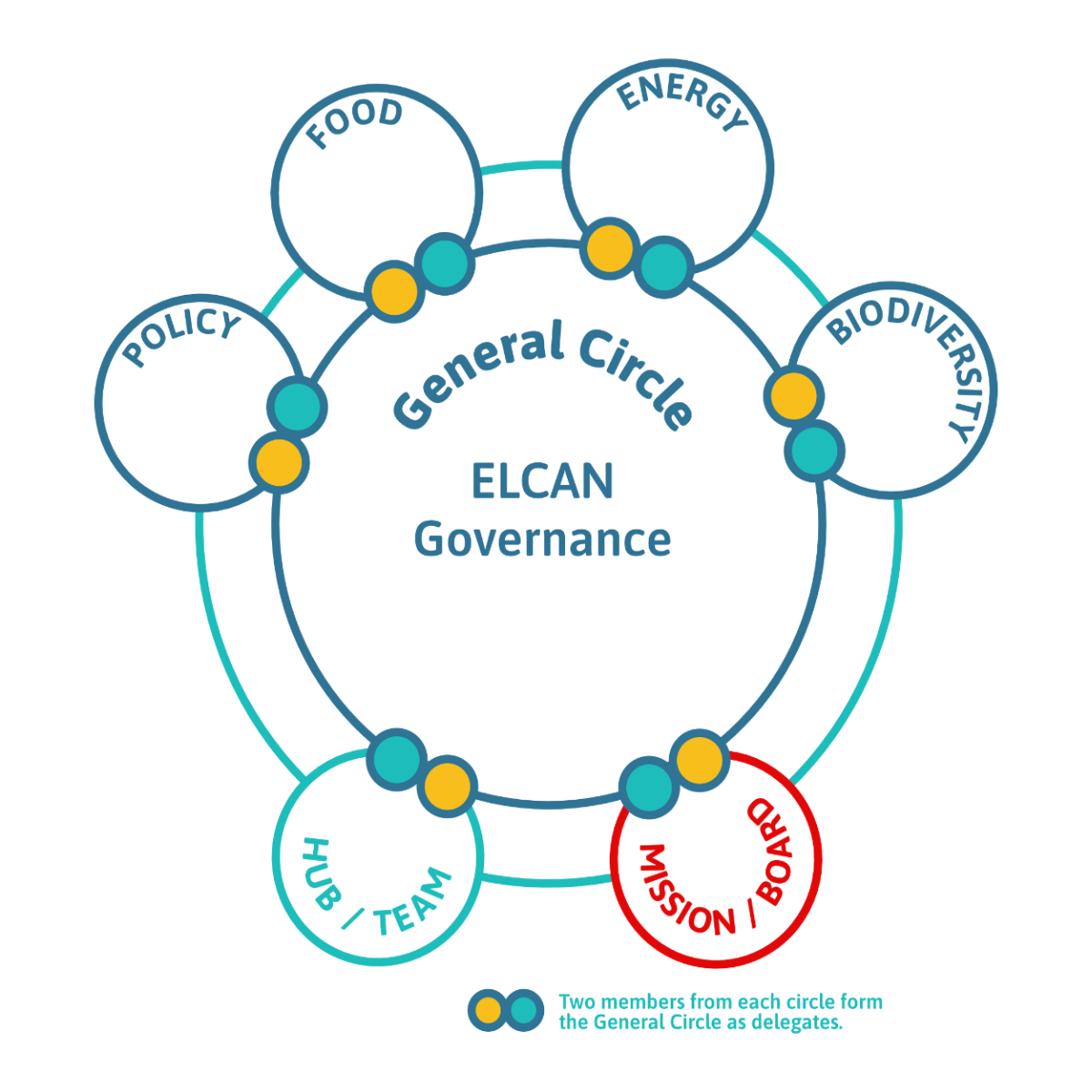
The differences between now and this aspirational future are:
- The Mission Circle and General Circle are currently the same. The General Circle doesn’t exist yet, but we will be establishing it in September.
- The Mission Circle and Policy Circle are established with an Aim & Domain, but the Staff Circle needs to do.
- The Biodiversity Circle is practically speaking the Biodiversity Collective, the Food Circle is the Food Growers Collective, and the Energy Circle is the emerging SE Scotland Regional Energy Network. However, these all will be undertaking the formal establishment of an Aim & Domain in the months to come, and the other aspects needed to interact with the General Circle, without delaying the great progress these initiatives are already making in their current forms.
In March 2026, ELCAN received confirmation of its SCIO status and progressed a transition plan from Lil CIC incubation to an independent charity. Lil CIC and its Board have been incredibly supportive throughout this process. Thank you! Sarah Bronsdon, CEO of Lil CIC, remains a Co-Chair of ELCAN’s Board. We are aiming for September 2026 for completion of this transition. At that point, the East Lothian Climate Hub project will be completely operated by ELCAN SCIO, along with our other current and future projects.
While having this conversation, it emerged that it would be beneficial for both organisations and individuals who live or work in East Lothian to feel they are members of ELCAN. Reasons include that relationships are built more between individuals than organisations in many ways, that we were finding that sometimes ELCAN organisational members had a single point of contact with ELCAN while others leading projects within that organisation were wanting to engage with and influence ELCAN, and that we want to be inclusive of climate action efforts in East Lothian – including with people who may not have time to engage with climate action in their community via an organisation.
So,
- What does individual ELCAN membership mean?
- What does organisational ELCAN membership now mean?
- How would voting work?
What does individual ELCAN Ordinary Membership mean?
Under our Constitution, individual membership now has a specific formal meaning. An individual aged 16 or over can become an Ordinary Member of ELCAN if they support the purposes of the organisation and live, work, volunteer in, or have a substantial connection to East Lothian. Ordinary Members are the legal members of the SCIO and have full voting rights. Employees of ELCAN cannot be Ordinary Members.
In plain English, this means individual members are not just ‘people on a mailing list.’ They are the democratic membership of the charity. They can attend members’ meetings, participate in ELCAN’s formal decision-making, elect Trustees, and take part in important constitutional decisions. The Constitution also makes clear that members are not personally liable for the debts of the organisation if it is wound up, although members and Trustees still have legal duties under charity law where those duties apply. Of course, if you simply want to receive the newsletter, keep informed, and potentially attend events, etc., then that is okay too.
Some individual members may simply want to also show support, attend gatherings, and vote at the AGM. Others may want to participate more actively by joining a Circle, Collective, working group, or collaborate to deliver a project. Membership does not require everyone to become highly active, but it does create a clearer route for people to move from interest, to participation, to shared leadership.
There is currently no fee / subscription to become a member, unless members agree to one at a future AGM. Anyone wishing to become a member applies in writing with a simple online form (for now, if interested then e-mail hello@eastlothianclimatehub.org and we will send you the form once it becomes available.) The Board will consider applications in a timely manner.
What does Associate (Organisational) ELCAN membership now mean?
Organisational membership also changes under the Constitution. Organisations, including community groups, charities, social enterprises and other not-for-profit bodies, can become Associate Members if they support ELCAN’s purposes. Associate Members are non-voting members. They can attend members’ meetings, receive papers and speak, but they do not have a vote or formal right of objection on members’ resolutions. Each Associate Member appoints one named representative as its main contact with ELCAN. Constituted groups must become Associate Members in order to receive benefits including applying for seed funding and using our projector and community co-working spaces.
Existing ELCAN member organisations will be invited to confirm that they wish to become Associate Members of ELCAN SCIO. This can be done through a simple online form, including confirmation that they support ELCAN’s purposes and naming their main organisational representative. The Board will then confirm eligibility and add them to the register of members.
This is a significant but sensible shift. Historically, ELCAN has been understood mainly as a network of organisations and community groups. That remains important. Organisational members continue to be a core part of ELCAN’s identity, legitimacy, and practical work. However, the legal voting membership of the SCIO now sits with individual Ordinary Members, rather than with organisations.
This helps solve a problem we had begun to notice: organisations are made up of people, and often more than one person in an organisation is involved in climate action. Sometimes one person may be the formal contact, while others are leading projects, attending events, participating in collectives, or wanting to influence ELCAN’s direction. The new model means organisations can remain connected as organisations, while individuals within those organisations can also join in their own right if they are eligible.
So, organisational membership should now be understood as partnership and participation, rather than legal control. Organisational members can help shape ELCAN through dialogue, participation in gatherings, involvement in Circles and Collectives, project collaboration, consultation and speaking at members’ meetings. But when formal SCIO member votes are needed, those votes sit with Ordinary Members.
How would voting work?
Both the Constitution and Our Way of Working point towards sociocratic consent decision-making: decisions should normally be made by general agreement, using rounds, discussion, reasoned objections and proposals that are “good enough for now and safe enough to try.”
Where a formal members’ decision is needed, each Ordinary Member present has an equal voice in consenting or objecting. If voting is required, each Ordinary Member has one vote. Associate Members do not vote and do not have a formal right of objection on members’ resolutions, although they may attend, receive papers and speak.
Most votes, where voting is used, are decided by a majority. However, some major decisions require a two-thirds majority. These include changing the Constitution, expelling a member, removing a Trustee, directing the Board to take or not take a particular step, amalgamating with another SCIO, transferring all assets and liabilities, or winding up the organisation.
Members’ meetings can happen in person, online, or as a hybrid meeting. The quorum for a members’ meeting is 20 members, present in person or online. Remote participation counts as being present, as long as members can hear and contribute to the discussion.
How does this connect to the Circles?
Our Way of Working says that ELCAN’s sociocratic circle structure is intended to spread responsibility and share leadership. Circles should have clarity about their Aim, their Domain, their membership and their authority. The General Circle, currently fulfilled by the Mission Circle, “decides who decides” by giving authority and responsibility to working circles and making sure the whole structure fits together.
This is important because individual membership does not mean every member decides every operational matter. That would quickly become unworkable. Instead, members hold the democratic foundation of the SCIO, while Circles hold defined areas of work. The Mission Circle / Board holds the charity’s legal governance, mission, strategy, charitable purposes, employment, finance and major risk responsibilities. The Staff Circle coordinates day-to-day delivery. Working Circles and Collectives carry forward practical and thematic work.
As the General Circle is established, the themed circles should each develop their own Aim and Domain. This includes the Biodiversity Circle, currently operating practically as the Biodiversity Collective; the Food Circle, currently operating as the Food Growers Collective; and the Energy Circle, currently emerging through the SE Scotland Regional Energy Network. This should formalise how they link into ELCAN governance without slowing down the good work already happening.
The General Circle should therefore be understood as a coordinating circle, not a second Board, not completely overlapping with ELCAN membership, and not a management committee for everything. Its purpose is to help clarify domains, support communication between circles, identify gaps or overlaps, and make sure decisions are being made in the right place. Operational decisions should remain with the Staff Circle or relevant working Circle wherever they are within that circle’s agreed domain and budget.
What happens next?
The practical next steps are:
- We will present this to our Members and record the presentation
- The Mission Circle will confirm its own Aim and Domain as a template for other circles.
- The Staff Circle will draft its Aim and Domain, making clear which operational decisions sit with staff and which decisions need escalation.
- The Biodiversity, Food, and Energy Circles will each draft their Aim & Domain
- ELCAN will make membership available to all eligible individuals
- ELCAN will invite current organisational members to become Associate Members
- ELCAN will establish the General Circle in September 2026 as a small coordinating circle, with appropriate links from the Mission Circle, Staff Circle and themed circles.
- ELCAN will explain clearly to members that the AGM is the formal legal members’ meeting, while regular ELCAN Gatherings can be used for wider participation, learning, feedback, celebration and shaping future work.
This gives us the best of both worlds: a legally sound SCIO with clear democratic membership, and a living participatory network where power and responsibility are distributed to the people closest to the work.
Thank you all for your continued support of community climate action in East Lothian!If you are interested in becoming an individual or associate member of ELCAN, please e-mail hello@eastlothianclimatehub.org and we will send you the form once it becomes available.