
2040 Vision
What could the world look like in 2040? How will it be, if we did all we could to tackle the nature and climate crises?
“We have less but live more... we borrow what we need.” “The world feels smaller, with shorter journeys... knowing our neighbours.” “Our highstreets have local shops that people can afford.” “Wildlife is buzzing everywhere: in our gardens, greenspaces, along streets, through our towns and countryside.”
How would you change East Lothian for the better, if it was up to you?
The visions were gathered between May to August 2024, at events, galas and harbour festivals, gatherings, holiday clubs, from children and at Fringe by the Sea. Invited by open-ended questions, under different themes, together they describe a collective vision for a more sustainable, flourishing and resilient East Lothian.
A collection of 1000s of “visions”, they have been used as a resource in secondary schools across East Lothian and inspired creative responses from across the region.
It has formed a collection of poems, pictures and artwork from school pupils and children in response to the 2040 Vision. It was used in a short story by award-winning writer Tim Porteus, published in The East Lothian Courier.
It is a look at the best possible outcome for a fairer, resilient, more sustainable future for South East Scotland.
An exhibition of youth visions
The 2040 Vision is an opportunity for future voices to be heard today.
A report published during COP26 found that 9 out of 10 Scottish children felt that climate change was something they were worried about but had little power over.
The East Lothian Climate Hub created the 2040 Vision exhibition to give a platform for young voices to express their hopes for Scotland.
The touring exhibition of over 70 works from local schools and youth groups has appeared at venues across the region, including the John Muir Birthplace Museum and the National Seabird Centre.
It has been seen by over 2000 attendees and has appeared on local TV and radio.
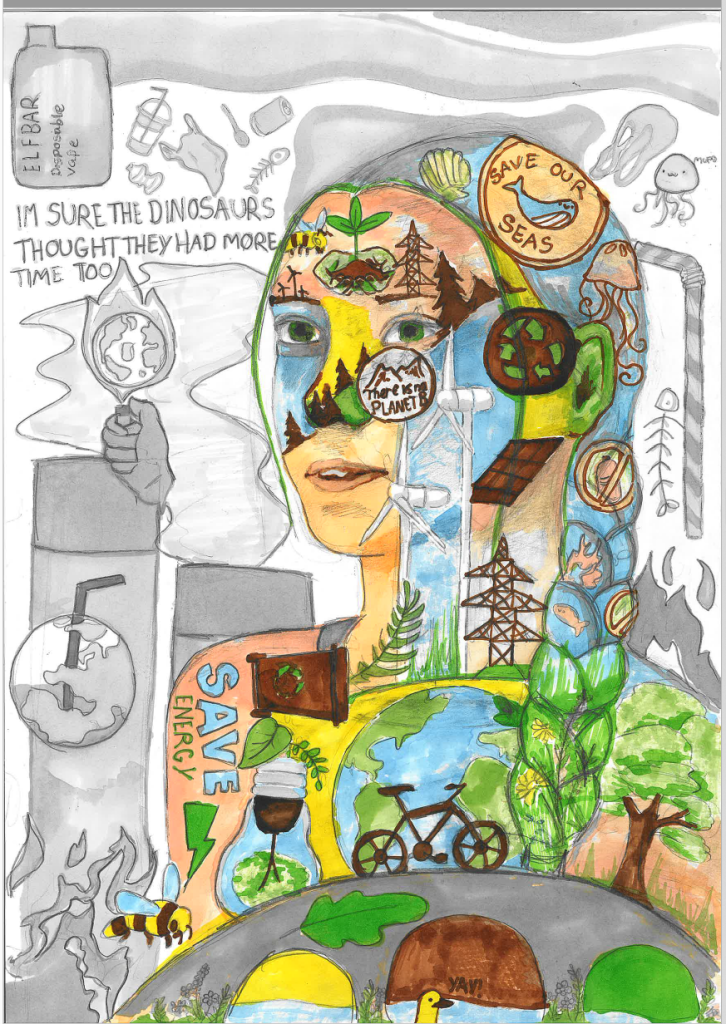
Imagining the year 2040
What is the East Lothian-wide vision for a thriving, sustainable future?
Click on the following themes for a glimpse of what Scotland could look like.
Community
“
People have time. People are connecting, sharing time, knowledge, laughter, questions. It looks like ‘we grew together, we care and we can!’. It is a place to live where we belong, we give and we receive. It looks colourful and bright. It feels uplifting, full of hope and health. It feels clean, fresh, safe. We are proud of being friendly. It feels alive
”
Biodiversity
“
Plant more trees and flowers. It makes me feel sad that our world is being destroyed and animals are endangered.
— a plea from a child
”
“
— What does it feel like? What is happening?
I can see and hear insects and birdsong, bees, butterflies, hedgehogs, wildflower meadows and trees. There is a diverse range of birdsong. There is a massive variety of tree / plant / hedgerow life brimming with insects and a massive array of birds, water vole, stoats, other water and land mammals. Endangered species are returning. Wildlife and biodiversity is buzzing everywhere: in our gardens, greenspaces, along streets, through our towns and countryside. Nature is busy and noisy.
The landscape is different, there have been deliberate decisions for wilder spaces for all our benefits. There are increased green spaces, more trees and space is dedicated to wildlife. Nature is returning on mass, is blossoming and is for everyone. Everyone knows and loves insects, butterflies, birds and other wildlife. There is an abundance of nature, vibrant and fecund, tended by happy, healthy children, with humans and nature living in respectful harmony.
Nature based solutions are the first choice / norm (not the exception).
When I’m walking around town there are lots of natural rewilded trees and long grass in and alongside our public spaces, and our coast lines. The towns and rural areas don’t feel so different from each other but are more blended in with nature, rural life is flowing through towns. There are trees alongside agriculture, our coasts, and wildflowers and extended woodlands.
”
Food
“
Arriving at the edge of my town on the train the fields looked so different, no longer monocrops but mixed farms and horticulture and orchards. I hope they are growing food for the town. I heard the supermarkets had closed long ago and been replaced by local shops .
I’m able to buy fruit and veg from a grocers that was grown in a field not too far away. Our food is healthy and regenerative to our and nature’s health. There are more green spaces for food to be grown. There is a strong emphasis on people growing their own food, either at home or on shared land.
”
Energy
“
I am looking on to community owned windmills, windpower, solar., local energy is produced. Buildings and houses have solar panels and are built / rebuilt in a way which makes them well insulated. We have community heating through a community owned local district heat network.
”
Circular economies
“
We own less and share more : this is the norm – we borrow what we need, through our informal networks. People are able to borrow more, consume less. Less needs to be manufactured. There are enough sustainable resources to meet the needs of the growing population
”
“
There are well paid green jobs and apprenticeships. Our high streets have local shops that people can afford. The cooperative movement has been revived.
”
Transport
“
We don’t travel as quickly or as far (there has been a change in tourism and travelling). We have a well linked network of active travel and cheap / free public transport options to expand non-car options in rural areas. It is safe to walk and cycle. More people scoot, cycle and walk places. There are very few cars and it is quieter.
”
Awareness
“
Most people are now committed and see the need for a local carbon lifestyle.
”
Local democracy
“
More devolved power to communities. There is a participatory relationship between people and councils. East Lothian Council gives priority to climate and biodiversity at each stage of any decision making or planning process
”
East Lothian Vision 2040 — Search Community Visions
| Category | Subcategory | Vision / Feedback summary |
|---|