To celebrate World Rivers Day, various groups in East Lothian hosted a weekend of events along and around the Tyne and the East Lammermuir burns, with support from ELCAN. Around 150 people took part in discussions, river sampling, guided walks, creative workshops and children’s activities. We spent time along the river, listening. We learned about what is undermining the life in and around the river. We started exploring what actions we could take, individually and collectively, to help the river thrive again. In this blog post, Olga Bloemen, one of the weekend’s organisers, looks back and summarises the learning.
“A river is a collaboration: it’s many streams flowing together
into one channel and eventually one sea.”
– Writer & river activist Robert Macfarlane (on the ‘Waterproof’ podcast)
24th September
Restoring the River Tyne – challenges & opportunities
East Lothian’s first rivers weekend opened on Thursday night, with a coming-together hosted by Balanced Horizon and Forth Rivers Trust. The hall in the Trinity Centre felt buzzing with folks who cared about their local river. We started off by remembering a place along the river special to us. Then we listened to John Maslen from Balanced Horizon giving us a birds-eye view of East Lothian’s rivers and burns. He pointed out that one of Scotland’s first mills, the 12th century Abbey Mill, was only a stone-throw away from the hall where we were gathered, though its original structures are gone. The mill was a harbinger of water-powered industries that had boomed all along the course of the Tyne. As such, John reminded us that the challenges facing the Tyne are the result of human interventions over centuries, and none of the solutions will be quick or easy fixes. He summarised the main pressures on the river:
- Historic legacy – barriers such as weirs & channel modifications
- Pollution from farm run-off and sewage overflow
- Land use intensity (mostly agriculture) and urbanisation
- On-going biodiversity decline
- Increase in invasive species
- Increase flood risk
- Droughts & increased water temperature

Many of us were surprised to hear that the Tyne has been assigned ‘Poor Ecological Status’ by SEPA. Part of the issue is that Scottish Water regularly discharges raw sewage into our rivers through combined sewer overflows (CSOs). Heavy rain easily overwhelms drainage systems that carry both rainwater and household wastewater in the same pipes.
In small groups, we spent time sharing anything we had observed recently regarding the state of our local river and its surroundings. The ubiquity of Himalayan Balsam and other Invasive Non-Native Species (INNS) was highlighted as well as the extremely low water levels over the summer. Someone mentioned how they felt that the river had improved significantly since the 60s, from smelling like sewage and harbouring little life, to the return of mallards and other waterbirds.
Mike Thornton, Senior Ecologist at Balanced Horizon, continued the presentation and shared more about their catchment-scale ‘Restoration Tyne’ project. Balanced Horizon (BH) has received funding from the Scottish Government to develop a catchment plan for the Tyne by March 2027, in collaboration with the Forth River Trust (FRT). This will focus on nature-based solutions such as creating ‘leaky dams’ upstream, planting riparian woodland, ‘re-wiggling’ the river, and restoring peatland and wetlands to restore the health of the river system. Cat Wright from FRT shared more details about the project’s methodology, developed by the River Restoration Centre, to map all the current pressures and assess which actions could make the biggest impact on river health. If more financial support is found, BH and FRT hope to be able to make this plan a reality, in partnership with other groups and with landowners.

By the end of the informative two hours, many of us felt that we needed more space for questions and conversation about the complexities of river restoration – hopefully more soon!
If you want to support the Restoration Tyne project in this development phase, you’re invited to share any relevant local knowledge, more info in this blog post.

25 September
River Fly Sampling
On Friday morning at the Linn Rocks, 12 of us bent over trays of water counting tiny invertebrates a volunteer had just fished from different spots in the river with a small net. One half of the group were part of East Linton’s Rivers Guardians group who meets every month to sample riverflies in the river, the other half had come to find out more about who lives under the water surface.
“Is this a regular Olive or a Blue-winged Olive?” “I think I found a freshwater shrimp!” There was cake and much excitement as we admired the amazing cases made by the Caddis Fly larvae, made from grit, sticks or whatever else they can find in the river.
Unfortunately, our count turned out to be below the “trigger score” for this location: there were fewer invertebrates than expected, which means we need to do it again in a few days to check if we got the sampling and counting right. If the score remains low, there may have been a pollution incident and we’d inform SEPA who’d come out and investigate further.
The river sampling is part of the Guardians of our Rivers project coordinated by Buglife. The project has trained over 900 people in 63 groups across Scotland, supporting them to become freshwater Citizen Scientists. In East Lothian, there are currently groups in Haddington, East Linton, Pencaitland and West Barns. If you’re interested in getting involved, please email us at riverkinproject@gmail.com and we can put you in touch with the local group coordinators.

Haddington RiverStories – History, Heritage and Nature
“Rivers run through people as surely as they run through places. (…) Our fate flows with that of rivers –– and always has…”
― Robert Macfarlane, in “Is a River Alive?”
Mike Thornton from Balanced Horizon and Cat Wright from Forth Rivers Trust took 17 of us on a guided walk along the Tyne, starting at the West Mills Weir in Haddington and ending just outside of Amisfield Walled Garden. They shared how the river became a source of power first for milling grain in medieval times, and later spinning and weaving and other industries that shaped Haddington. But the river has always been much more than a driver of industry. One Haddington memoir recalls children fishing eels and other fish along the river between Clerkington and Amisfield, hunting for moorhen eggs, exploring the Poldrate Mill lade and swimming at the Cram.
Cat pointed out how weirs impact the river: not only do they block migratory fish wanting to move up or down the river, they also disturb the natural processes of erosion and deposition and hinder the creation of diverse habitats for all sorts of creatures. (This short video shared by Cat explains it more). While none of the weirs serve their original function of allowing water to be diverted into the mill lade, they are seen as part of Haddington’s industrial heritage. Weir removal is often complicated and costly – but may ultimately be necessary for a river to support more life.
Mike and Cat were extremely knowledgeable and folks in the group pitched in insights and stories too. By the end of the walks our heads buzzed with learning, and we felt that we’d never look at the river the same way again.

26th September
Sketch & Wander: Flow with the River Tyne
On a sunny Saturday afternoon, a group of us gathered on ‘the Haugh’ (Scots for riverside meadow) next to Haddington’s old Poldrate Mill with, local artist, Lynn Fraser. Under the bridge, she shared part of Mary Oliver’s poem ‘At the River Clarion’. Then we mindfully walked upstream along the Tyne, and as we slowed our pace our minds slowed too and our senses opened: Herons, still like statues, golden sunlight through the thistle down, and a classic shopping trolley stranded in the river, collecting soggy autumn leaves.
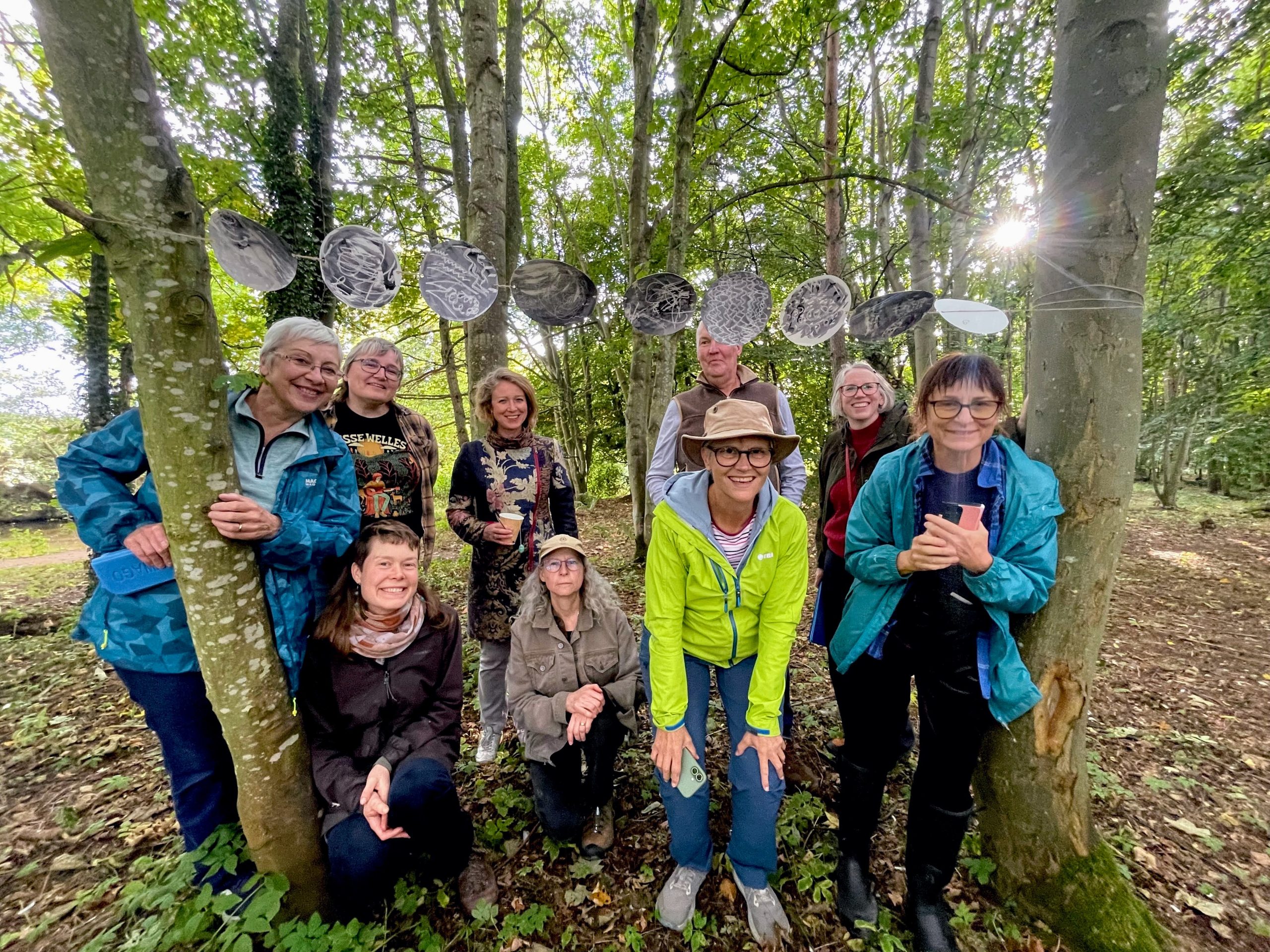
Down on the riverbank, Lynn showed us how to do ‘pebble pushing’, tracing pebbles on our papers by pen, and got us completely immersed. We then filled pens with river water and used blue and green pigment to add colour to our doodlings. A bit further upstream, we made a sound map of all the natural and human-made sounds we could hear: the wind whistling in the huge beech tree, the babbling water, croaking rooks and a nearby grass mower. On a paper circle, we then did our last creative activity: with white candlewax we made markings responding to the river sounds around us, and then we traced over it with oak gall ink to reveal what we made. Together, these ‘harvest moons’ on the day of the full moon revealed wonderful, intricate patterns, as if we had made something invisible visible. We left feeling renewed and with a deep fondness of the river along which we had spent these precious, playful hours.
You can find out more Lynn Fraser’s work here: https://www.instagram.com/fantooshsketching/


27 September – World Rivers Day
On Sunday morning, our walkshop ‘Contemplations on our Connection to Nature’ with Andy Smith (one of the weekend’s organisers) had to be postponed due to illness. This nature connection walk will now take place on Sunday morning the 11th of October. If you’re curious to take part, just email riverkinproject@gmail.com.
Drop-in Children’s Activities
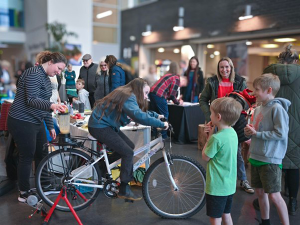
Friends of the River Tyne (FORT) organised a free afternoon of river-themed art activities in the Trinity Centre, to celebrate World Rivers Day. It was a rainy afternoon, and many families were glad to find an exciting and dry place to spend an hour or two. Kids could paint pebbles, make otter masks and river crowns, be calmed by water ripples in a cosy, sensory tent, listen to stories, and lots more. The 10+ activity stations were manned by FORT volunteers and local primary school teachers, coordinated by Audra Buist, long-term member of FORT.
FLOW exhibition
A steady stream of folks joined the final day of the FLOW exhibition at John Muir’s Birthplace in Dunbar, to learn about progress of Sustaining Dunbar’s Rivers Project and to get a taste of creative workshops to come with some natural printing.
What’s next?
The small team behind the festival is looking forward to organising more river events and gatherings this Autumn/ Winter, and next year. We’re keen to explore how we can take more collective action for the health of our rivers, and all the life that depends on it! If you want to stay in the loop, you can leave your contact details in this form.
Do support / join in with the work of the groups who collaborated on East Lothian’s River Festival:
The River Guardians groups in East Lothian
You can find an overview of their work here: eastlothianclimatehub.org/elcan-east-lothian-river-connections/
We’re very grateful for all the support from the East Lothian Climate Action Network (ELCAN)!
Also, don’t miss these two wonderful river festivals coming up later this month:
The Catchment Festival on 17th October in the Leven catchment in Fife.
The Tweed River festival on 30-31 October
Further Resources
The River Restoration Centre has a manual of river restoration techniques which gives an idea of some of the methods that can be used to restore natural processes to rivers (but note there are lots of factors which affect which river restoration techniques can be applied to a river e.g. energy, land use, geology, existing structures, and many won’t be applicable to the Tyne and its tributaries): Manual of River Restoration Techniques | the River Restoration Centre.